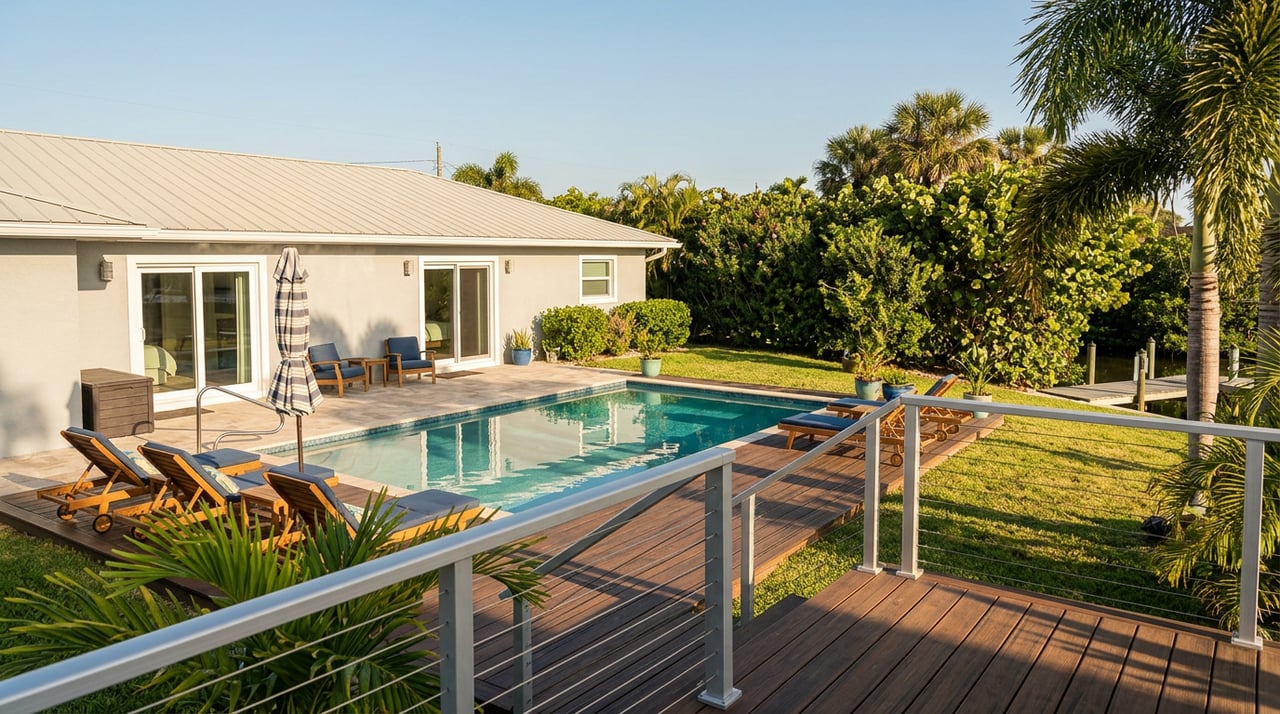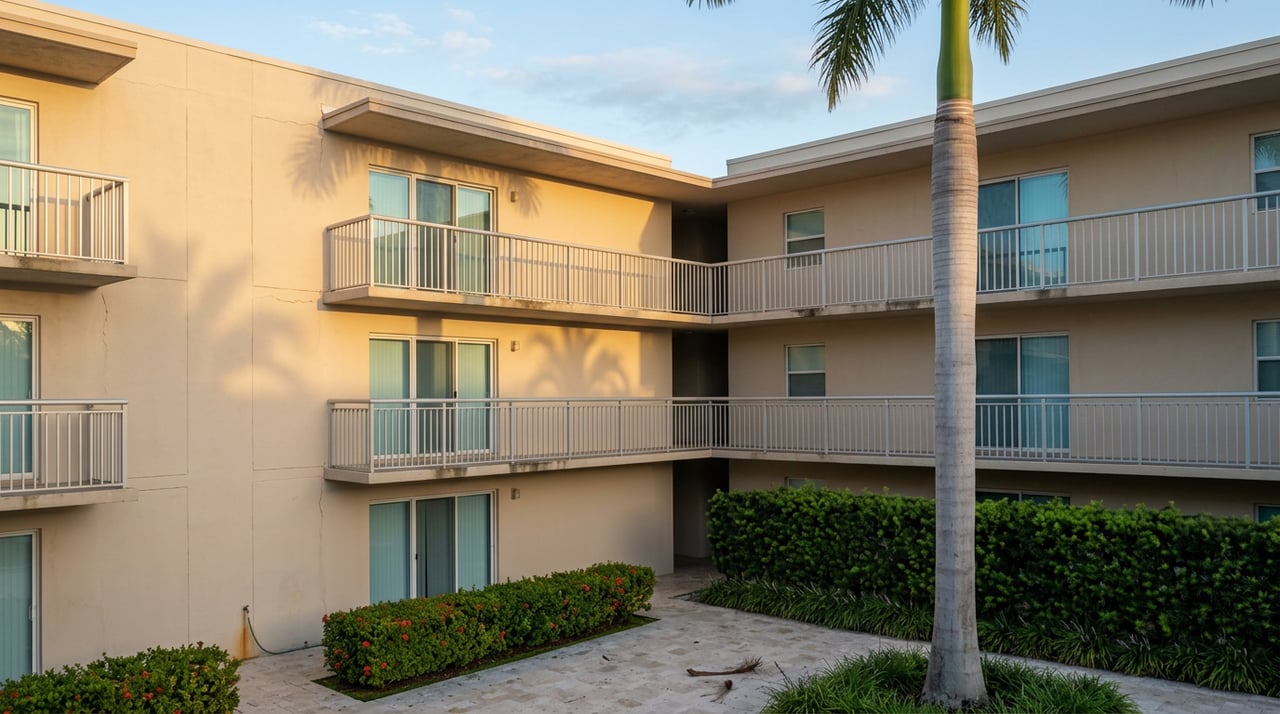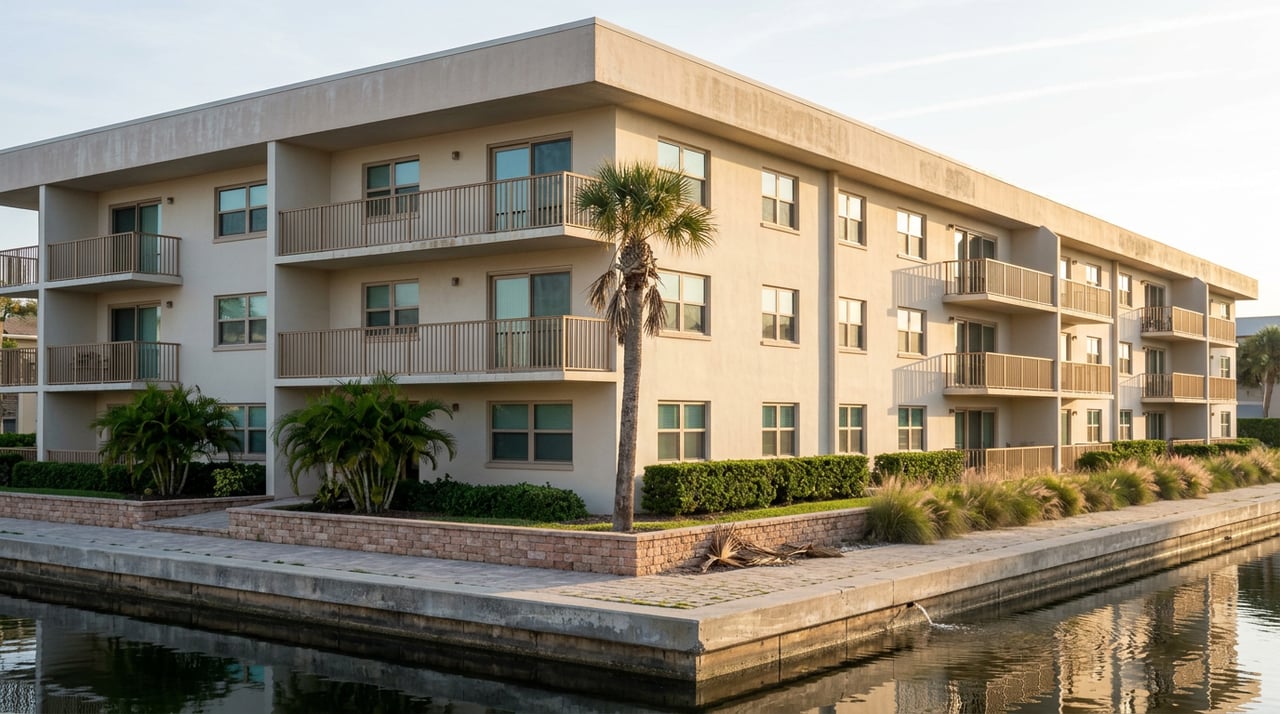
Pull up two Hutchinson Island listings priced within a few thousand dollars of each other and you'd expect them to look roughly the same. They don't. One is a two-bedroom unit in a low-slung 1980s building a short walk from Sailfish Point, capped at four stories because the county says so. The other sits on the 14th floor of a tower with sweeping views of both the Atlantic and the Indian River Lagoon, a building type that couldn't legally exist a few miles south.
Same island. Same asking price range. Completely different product. The reason isn't the market. It's a zoning line drawn four decades ago that happens to run through the middle of a barrier island most buyers assume is one continuous stretch of sand.
The Ordinance That Drew the Line
Hutchinson Island splits into two pieces at the Fort Pierce Inlet. South of the inlet, the island sits in Martin County. North of it, St. Lucie County takes over. That county line has shaped the physical housing stock more than any market cycle has.
Martin County has held building heights on the island to four stories since 1984, and the result is a skyline that simply stops climbing. There are no high-rises and no mid-rises on the Martin County stretch, only low-rise condos and single-family homes tucked behind dune lines near communities like Sailfish Point, Indian River Plantation, and the gated Key West-style enclave at Watersong.
Cross the inlet into St. Lucie County and the rules loosen. Buildings like Tiara Towers rise 14 floors above Fort Pierce's North Hutchinson Island, and communities such as Ocean Harbour North pack in two pools, two clubhouses, a private marina, and tennis and pickleball courts around a taller footprint. The county didn't just allow more height. It allowed a different kind of building entirely, one built for density and amenity stacking rather than a low profile against the dune line.
What $525,000 Actually Buys on Each Side
Here's where the story gets interesting for anyone comparing the two halves of the island using nothing but a median price. Over the three months ending in May 2026, the Martin County stretch of Hutchinson Island (the area sometimes labeled Hutchinson Island South) posted a median sale price of $524,686, down 4.6 percent from the same period a year earlier. Homes there were taking longer to sell too, averaging 104 to 108 days on market compared to 79 days the year before, with a sale-to-list ratio of 93.7 percent.
On the St. Lucie County side, the median home price in Hutchinson Island North (the Fort Pierce section) was $525,000 as of April 2026, with an average sale price of $545,587. Condo listings there ranged as wide as $265,000 up to $1,595,000, a spread that reflects everything from smaller, older units to newer high-rise inventory.
Line those two medians up and they're essentially identical, separated by less than $400. But identical medians are hiding two different housing eras and two different amenity packages:
| Martin County (South) | St. Lucie County (North) | |
|---|---|---|
| Height limit | 4 stories, in place since 1984 | Mid-rise and high-rise permitted |
| Typical building age | 1980s and 1990s | Wider range, includes newer towers |
| Median sale price | $524,686 (3 mo. ending May 2026) | $525,000 (as of April 2026) |
| Days on market | 104-108 (up from 79 a year prior) | Not directly comparable in same window |
| Example communities | Sailfish Point, Indian River Plantation, Watersong | Ocean Village, Harbour Isle, Ocean Harbour North, Tiara Towers |
The takeaway isn't that one side is better. It's that a buyer using the median price alone to decide between the two is comparing a number, not a building.
The Bridge That Just Rewired the North End
While the height difference between the two counties has been stable for forty years, something on the north end changed this year in a way that's worth separating out from the noise. On May 15, 2026, the Florida Department of Transportation opened a new $115.9 million fixed-span bridge connecting mainland Fort Pierce to North Hutchinson Island, replacing the D.H. "Banty" Saunders Drawbridge that had served as the only crossing since 1954.
The difference isn't cosmetic. The old drawbridge offered a navigational clearance of just 25 feet when closed. The new span clears 85 feet, and its horizontal clearance widened from 90 feet to 125 feet, letting boat traffic pass underneath without stopping cars above. Because it's a fixed span rather than a moveable one, it also doesn't carry the same high-wind closure procedures that used to strand drivers during storms, though local law enforcement can still close it at their own discretion when conditions call for it.
This upgrade applies only to the north end of the island. The Martin County side still relies on its existing crossings, including the Ernest Lyons Bridge and the Jensen Beach Causeway, both unaffected by the Fort Pierce project. So the two counties that already diverge on building height now also diverge on how recently their access infrastructure was rebuilt, another variable that doesn't show up in a median price comparison but shows up the first time a storm forecast rolls in.
What This Means If You're Comparing the Two Sides
If you're weighing a purchase on Hutchinson Island and the two counties are both on your list, a few things are worth checking before the price tag does the talking:
- Ask the building's age, not just its price. Many Martin County condos date to the 1980s and 1990s. That's not a disqualifier, but it means association financials and building condition deserve a real look, not a glance at the listing photos.
- Understand what the height cap buys you and what it doesn't. Four stories means quieter sightlines and a smaller building footprint. It also means less of the amenity stacking (multiple pools, larger clubhouses, elevator banks) that comes standard in some of the taller north-end buildings.
- Factor in access, especially for storm season. The new North Causeway Bridge changes the calculus for evacuation timing on the St. Lucie County side. If you're comparing a north-end unit to a south-end one, that's a genuine difference in infrastructure age, not just a marketing point.
- Don't let a matching median convince you the products match. As the numbers above show, two very different housing types can land on nearly the same price by coincidence of timing, not because they're interchangeable.
None of this makes one county the better buy. It makes the two counties different products wearing the same barrier island, and worth pricing out on their own terms rather than through a single blended number.
A Few Questions Worth Asking Directly
Does Martin County's four-story limit apply to single-family homes too? The height cap is part of Martin County's broader comprehensive plan and applies countywide, though most single-family homes on the island were never going to approach four stories in the first place. Where it matters most is in condo development, where it's kept the Martin County side of Hutchinson Island permanently low-rise.
Will the new bridge change insurance costs or evacuation planning for north-end residents? The fixed span eliminates the old drawbridge's high-wind closure procedures, which should mean fewer weather-related access interruptions. Local authorities still retain discretion to close the bridge during active storm events, so it's a meaningful upgrade in access, not a guarantee against every closure.
Is the south end or the north end the stronger investment right now? Both sides posted median prices near $525,000 in recent months, but the south end saw longer days on market and a year-over-year price dip, while the north end's wider price range reflects a broader mix of older and newer inventory. Which side performs better for a given buyer depends more on the specific building and its financial health than on which county it sits in.
If you're trying to figure out which side of that inlet actually fits what you're looking for, Renny Realty has spent enough time on both halves of Hutchinson Island to tell you what a listing's price tag isn't showing you. Schedule a consultation and we'll walk the comparison building by building, not just median by median.