If you've lived near Bathtub Beach for more than a few years, you already know it closes more than it should. What you might not know is that the version of "closed" changed this year, and so did the reason.
The physical fixes to the beach and the road that leads to it have mostly landed. The buried seawall is in the ground, the parking lot has been redone, and the county says the reef is healthy. But a separate protection that has nothing to do with concrete or sand is currently sitting in front of the Martin County Commission, unresolved, and it's the one that determines how close someone can legally chum for sharks while your kids are standing in the reef's shallow pool.
The Seawall Nobody Sees
The beach reopened in January 2025 after an 18-month closure tied to a hazard mitigation project that buried a seawall under the dune line east of the parking lot. Public Works Director Jim Gorton described building a seawall going down 23 feet that protects the parking lot and infrastructure on that side of the road. The wall is designed to stay invisible under normal conditions. It only does its job when a storm has already stripped the beach down to nothing, which is precisely the scenario that used to force emergency sand-trucking after every nor'easter and hurricane season.
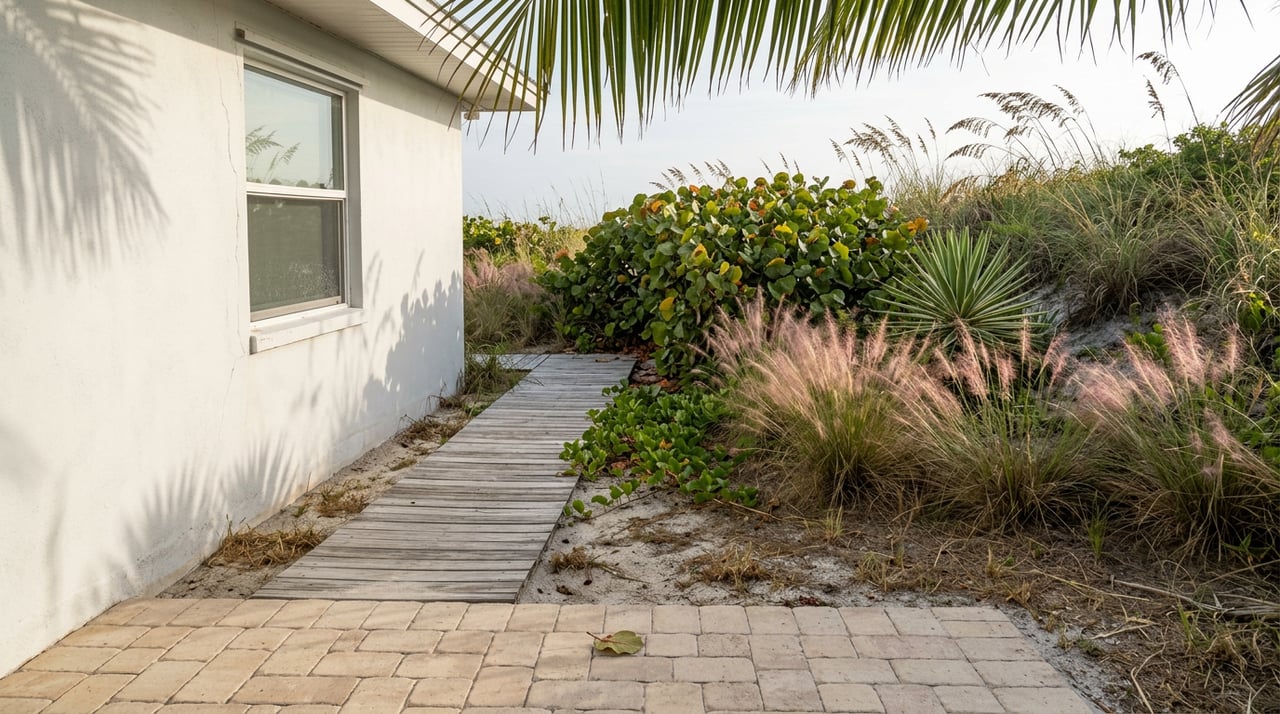
The improvements went beyond the wall itself. The parking lot got a makeover, with a new sidewalk, improved drainage and landscaping. That drainage change matters more than it sounds: water that used to be discharged from that parking lot straight into the estuary is now getting treated before it goes out to sea, according to Gorton. And the reef that gives the beach its name wasn't harmed by the construction. Gorton said the reef is in great shape, noting the county monitors it during and after every project.
The full MacArthur Boulevard Resilience Project breaks into two phases: shoreline stabilization and roadway elevation. The seawall covered the first. The second phase, raising the road itself, is where the story gets more complicated than a single reopening headline suggests.
The Road Still Catching Up
By Gorton's account in January 2025, the county had already raised a section of MacArthur Boulevard from elevation two to elevation five as part of that same 18-month project. That would seem to close the book on flood-proofing the road. It doesn't.
A report from March 2026 describes a second, distinct stretch of MacArthur Boulevard still waiting on the same treatment, and it says the beach had closed again to move that work forward. The most vulnerable section of MacArthur Boulevard sits between Bathtub Beach and Sailfish Point, runs about 1,100 feet, and was reported at 2.5 feet of elevation, well below FEMA's guideline. Once that phase is complete, the road is set to reach 5.25 feet. In other words, the county fixed the segment closest to the beach access first, then turned its attention to a longer, lower stretch heading toward Sailfish Point, and that second push was still active as of that March 2026 report. The renovation is expected to cost around $5.6 million, with the county covering roughly 25 percent and FEMA picking up the rest.
For residents, the practical read is this: any partial closure you've seen at this beach earlier this year likely wasn't a repeat of the 2023-2025 project that already reopened. It's the next segment of the same multi-year plan, aimed at a different, lower stretch of the same road, and it's worth checking current status before you plan a visit rather than assuming last year's reopening covers this year too.
A Different Kind of Protection Is Now Being Rewritten
Here's the part that has nothing to do with sand. On August 1, 2026, Martin County commissioners began weighing changes to the local shark fishing ordinance after the Florida Fish and Wildlife Conservation Commission directed the county to align its rules with state regulations, a move that drew significant public concern.
The mechanism is preemption. There's a state statute that has essentially taken the power to regulate saltwater fishing, including shark fishing, away from the county, according to Assistant County Attorney Melissa Petrick. The number that actually matters here is a distance, and it's the one most coverage glosses over. Martin County's current code still sets its own line: it's unlawful to shark fish or attempt to shark fish from county property within a minimum of 1,000 yards of the boundaries of a full-service beach park at any time. That's three times the buffer implied by state law, which requires a saltwater fishing license and special permit for shark fishing and allows it within 1,000 feet of a guarded beach at all hours. The county's stricter yards-based rule is the exact thing now up for rewrite.
County attorneys aren't proposing to erase the local rule outright. State law recognizes an exception allowing local governments to prohibit saltwater fishing on county-owned property when necessary to protect public health, safety and welfare, and the proposed amendment addresses that by prohibiting fishing within guarded beaches during guarded hours. County Attorney Elysse Elder put it plainly: the county can rework the wording to not completely remove it, but to reference state law instead, the way it does in other parts of the code. Commissioners tabled the vote and sent staff back to redraft language after hearing from the public.
As CBS 12 reported, local surfer Jay Noyes told commissioners he'd been caught in shark fishing lines himself. Dottie Lanci, a member of the Hutchinson Island Preservation Initiative, opposed loosening restrictions and cited an incident she witnessed near her home where anglers used drones to drop chum into the water. Marine conservation researcher Dr. Justin Grubich made the sharpest argument for keeping the buffer:
"There's new scientific evidence or more accumulated scientific evidence that you can create problem sharks like problem bears."
Indian Riverkeeper Jim Moir went further, asking commissioners to look into whether local waters could see broader restrictions on shark fishing entirely, arguing the animals matter to the ecosystem and that offshore anglers are already losing catch to sharks.
A past shark-bite incident at Bathtub Reef Beach has also figured in local beach-safety discussions.
The ordinance is expected to return for further discussion at a future commission meeting, so nothing here is final. What's confirmed is that a proposed change to the buffer distance is still a draft, not a settled fact.
What to Actually Check Before You Head Down
The beach itself is open and testing well. As of the state's most recent sample, water quality at Bathtub Public Beach was rated good, meeting acceptable standards for recreational use, as of July 5, 2026. That's a snapshot, not a live feed, so for day-of conditions the better tool is the county's own system:
- Martin County Ocean Rescue staff are on duty daily from 10 a.m. to 4:45 p.m., and the county's Safe Beach Day tool provides real-time surf and weather conditions, tides, warning flags, rip current and marine life alerts, beach closures, and lifeguard tower availability.
- The reef-protected pool that gives the beach its nickname only shows up on the right tide. As longtime local James Ferro put it in CBS 12, when it's low tide, it's like a big bathtub, and that's when kids can actually play in it. Check an outgoing tide before you plan around the calm-water effect.
- The beach itself sits at 1585 SE MacArthur Boulevard in Stuart, at the base of the road segment currently being raised.
The Two-Track Reality
The infrastructure story is mostly a good-news story with an asterisk: the seawall is in, the drainage is fixed, and the reef checked out healthy, but the county is still mid-stride on the next stretch of road toward Sailfish Point. The ordinance story has no ending yet. One track is concrete and largely finished. The other is language, still being negotiated, and it's the one that actually decides how close a boat with a bucket of chum can legally get to the water your family swims in.
If you're weighing what a home near this stretch of Hutchinson Island is really like to live with day to day, that's exactly the kind of layered, current-events context that doesn't show up in a listing sheet. Renny Realty tracks these local threads because they shape what it's actually like to own here, not just what it costs. If you have questions about this stretch of the Treasure Coast, schedule a consultation and we'll walk through what we're seeing on the ground.
This article is general information, not legal, tax or financial advice. Consult a qualified professional about your situation.